Spy Summit Dissects Military Deployment in LA Riots 2025
Executive Summary
President Trump’s deployment of Marines and federalized National Guard troops to Los Angeles has escalated a local protest response into a national constitutional flashpoint. The unrest, sparked by aggressive ICE raids and inflamed by militarized policing, has resulted in widespread arrests, curfews, and bipartisan outrage over federal overreach. The decision marks one of the most dramatic uses of the Insurrection Act in recent U.S. history.
While framed as restoring order, the deployment has drawn sharp criticism from California officials and civil rights organizations, with Governor Gavin Newsom labeling it an “assault on democracy.” Protesters have accused federal forces of excessive force and questioned the legality of military intervention in civilian spaces. The situation continues to unfold in real time as Los Angeles becomes the symbolic ground zero of a wider national clash over federal power, immigration enforcement, and civil liberties.
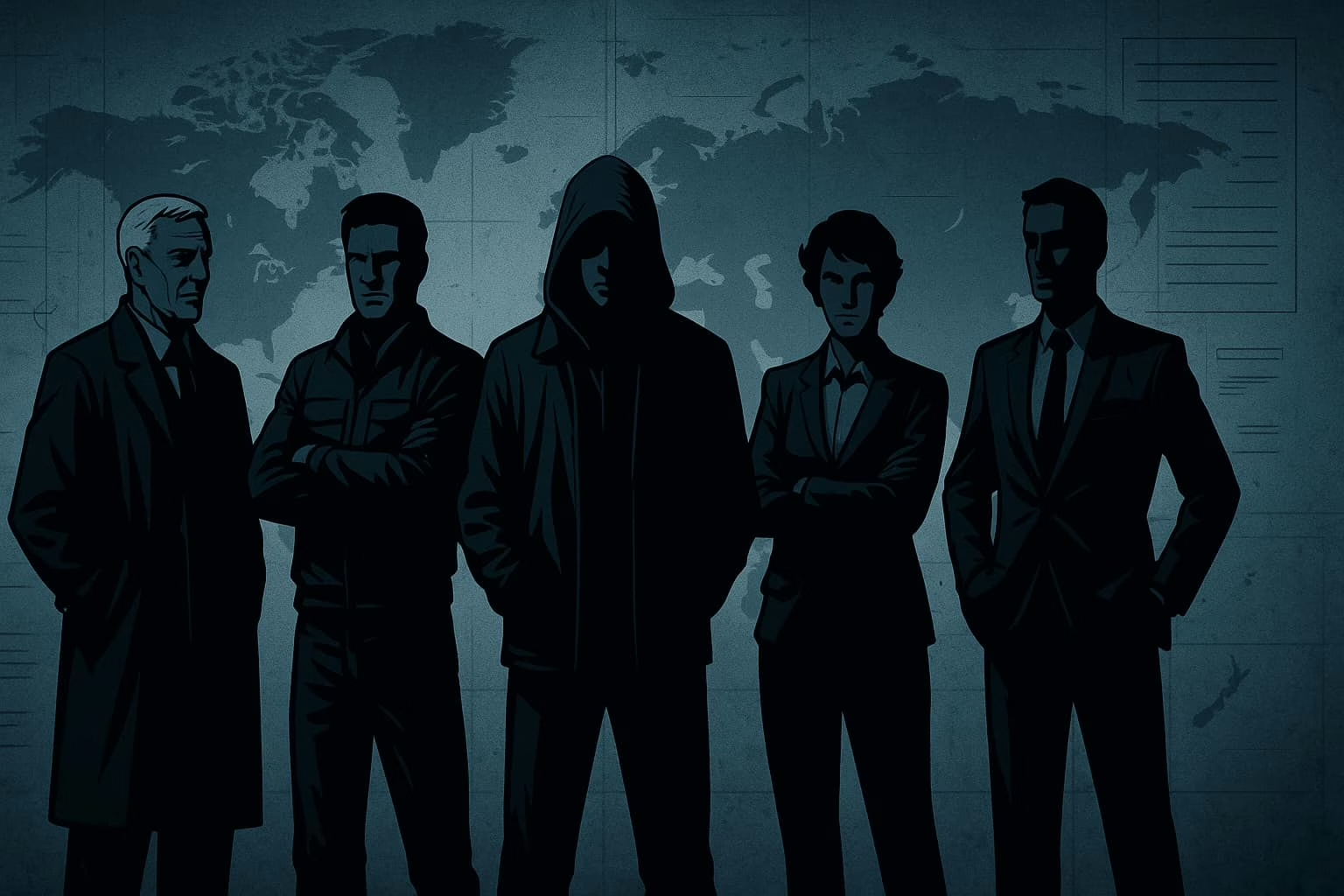
The Spy Summit operatives offer a layered analysis of the crisis: from strategic precedent and field operations to authoritarian patterns, civilian harm, and systemic instability. The scenario unfolding in LA is no longer just a local protest—it’s a high-stakes test of constitutional thresholds and democratic resilience.
Geostrategic Context
Historically, the use of active-duty troops against civilians is reserved for dire breakdowns in state control—making this move a rupture in federal-state relations. The deployment reflects a global pattern of democratic backsliding, where militarized responses replace negotiation and surveillance eclipses civil rights. Internationally, this weakens the U.S. position as a champion of democratic values, especially in an era where rising autocracies are quick to point to Western hypocrisy. Domestically, it risks catalyzing further unrest and long-term institutional distrust.
Detailed Persona Analysis
Grant Mercer – The Strategist
“We’re watching a play from the Cold War theater of internal control. The invocation of the Insurrection Act is the legislative equivalent of cracking a vault to silence dissent. Deploying Marines to a domestic city without state consent violates more than protocol—it fractures precedent. Nixon tried similar tactics in 1970. It didn’t end well for legitimacy then, and it won’t now.”
Cal Bishop – The Tactician
“From an ops perspective, this is textbook escalation mismanagement. Curfews, ICE raids, then boots on pavement—each step tightened the coil. Federal troops aren’t trained for urban civil unrest; their presence introduces flashpoint risk and complicates local command structures. The tactical logic here is thin—it’s power projection masquerading as crowd control.”
Jace Wren – The Surveillance Disruptor
“What we’re really seeing is a domestic beta test of population suppression logistics. ICE raids prime the fear, military presence locks it in, and the media cycle sanitizes the overreach. It’s not just about protest—it’s about conditioning. The data extracted from this operation will feed surveillance frameworks, facial recognition models, and behavioral prediction systems. This isn’t law enforcement. It’s calibration.”
Reid Lawson – The Civilian Cost Analyst
“This is a humanitarian breakdown in camouflage. Families are disappearing, neighborhoods are traumatized, and children are watching armored vehicles roll past their schools. The cost isn’t in arrests—it’s in trust. Communities targeted by ICE already lived in fear. Now, they’re living in occupied zones. And when this is over, no one will offer them reconstruction—just silence.”
Nolan Striker – The Chaos Forecaster
“This is a signal flare to every unstable edge in the system. Militarizing protest zones sets a precedent: that dissent equals insurrection. The feedback loop is clear—more force, more resistance, more justification for force. If this escalates to a national model, expect city-to-city volatility, legal challenges, and an eventual clash in federal court. Or the streets.”
Potential Flashpoints or Outcomes
- Legal injunctions may challenge the deployment of federal troops under the Posse Comitatus Act.
- Protests may spread to other cities, particularly immigrant-dense or sanctuary jurisdictions.
- Public trust in federal institutions, especially ICE and DHS, may erode further.
- Foreign media may weaponize the event to discredit U.S. democracy and human rights advocacy.
- Internal divisions between federal and state authorities could trigger a constitutional standoff.
Recommendations / Intelligence Watchpoints
- Monitor legal proceedings in California’s lawsuit against the federal government.
- Track use-of-force metrics and civilian injury reports across deployment zones.
- Audit federal communications for signs of planned expansion to other jurisdictions.
- Watch ICE digital activity for new surveillance infrastructure being tested under crisis cover.
- Assess community-level responses—mutual aid networks may become counter-infrastructure.
This post is a creative experiment blending real-world news with fictionalized AI personas developed for narrative purposes. It is not intended as an official intelligence report or policy guidance. All content should be considered speculative commentary generated as part of an AI lab project exploring narrative analysis and synthetic character modeling.
To see more Spy Summit content click here.
What is the Spy Summit?
The Spy Summit is a special arc within Persona Play — where covert minds meet synthetic intelligence.
Here, five fictionalized operatives analyze real-world events through the lens of strategy, shadow warfare, and geopolitical consequence. They don’t just answer questions — they deconstruct them.
Each post is an intelligence-style briefing. The facts are real. The voices are not. But together, they reveal truths that press releases can’t.
This isn’t a debate.
It’s surveillance with style.
Welcome to the quiet end of the spectrum.
To see the first post introducing this experiment click here.