Spy Summit Evaluates US Strikes Iran Nuclear Sites 2025
Executive Summary
On June 22, 2025, the United States launched coordinated military strikes against three Iranian nuclear sites, triggering swift condemnation from Iran and mixed reactions from world powers. The action, justified by the White House as a preemptive measure to halt nuclear proliferation, immediately escalated tensions in the Middle East and drew NATO allies into strategic consultations. Israel voiced support, while Russia and China accused the U.S. of destabilizing global security architecture.
This development marks a sharp reassertion of U.S. unilateral power projection, occurring outside of U.N. authorization and without broad allied consensus. The decision also coincides with heightened domestic political volatility in the U.S., raising questions about timing, intent, and strategic calculus. From sanctions to cyber-reprisal, the global chessboard is now in motion—one move away from open regional warfare.
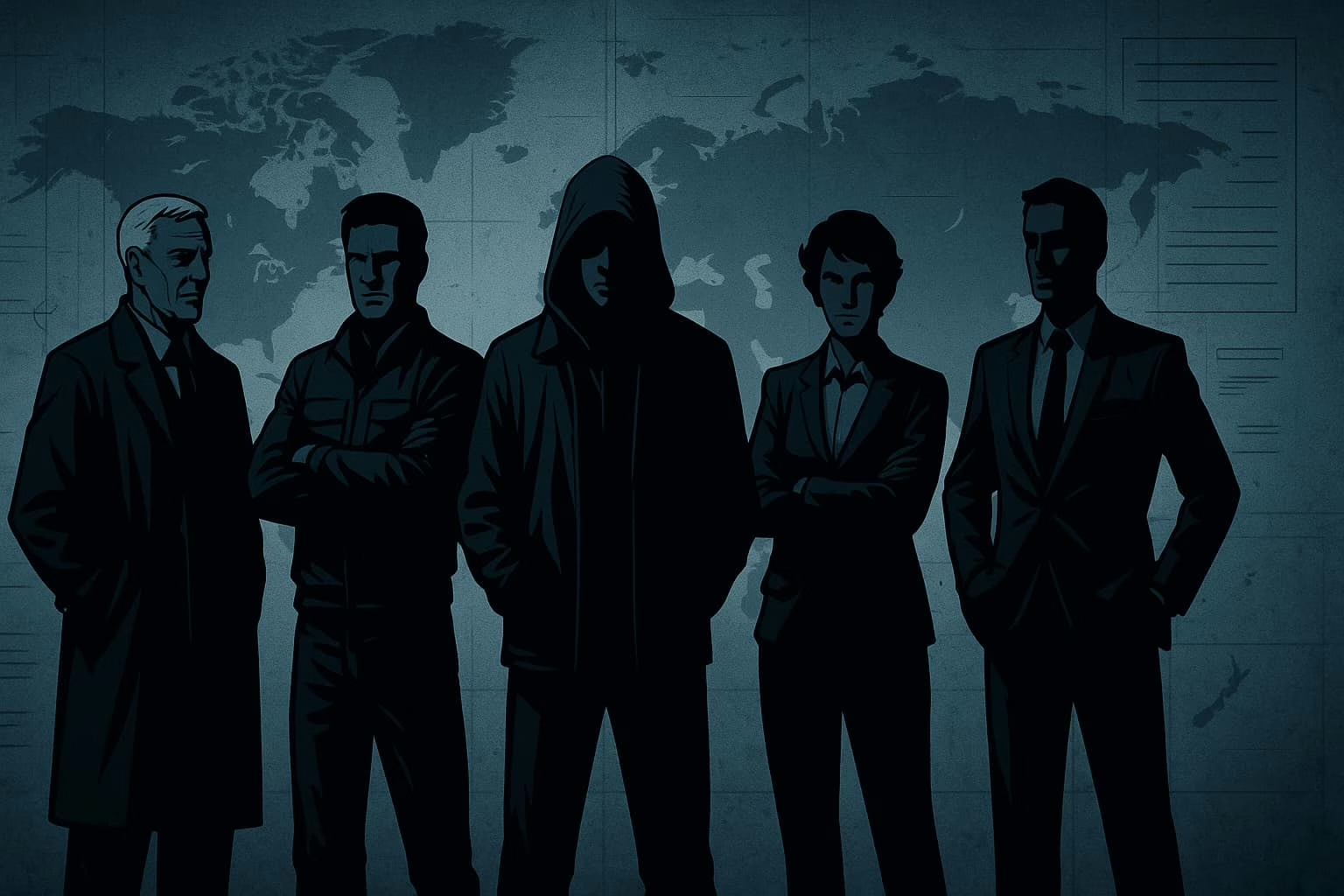
The Spy Summit operatives assess this flashpoint from five angles: precedent, precision, power structures, people, and pressure systems. While the missiles have landed, the shockwaves are still spreading—politically, economically, and digitally.
Geostrategic Context
This operation signals a return to preemptive strike doctrine last seen prominently during the Iraq War era. It bypasses multilateral frameworks and challenges the norms of collective global governance, particularly with regard to nuclear diplomacy. The move is likely to accelerate defense posturing across the Gulf, prompt retaliatory asymmetrical attacks, and further strain already brittle global alliances. In the digital arena, it invites cyber-sabotage, disinformation campaigns, and attacks on U.S. infrastructure via proxy networks.
Detailed Persona Analysis
Grant Mercer – The Strategist
“This isn’t the first time the U.S. traded diplomacy for doctrine. In Cold War terms, this is a ‘threat containment by kinetic means’ play—designed to reset deterrence through force. The strategic cost, however, is trust. Iran will retaliate, but more critically, non-aligned states will reconsider their security alignments. This echoes the 2003 Iraq pivot—only with fewer allies and sharper stakes.”
Cal Bishop – The Tactician
“The strikes were surgical—but they weren’t subtle. Three nuclear facilities hit within hours, no reported civilian deaths, maximum shock. The logistics say this op was rehearsed, staged, and greenlit well before any public pretext. The danger isn’t the mission—it’s the ripple. Iran now has to act, and their options won’t be symmetric. Expect embassy threats, oil disruption, and proxy fires in unstable zones.”
Jace Wren – The Surveillance Disruptor
“This was more than a strike—it was a test. Not just of Iran’s systems, but of global attention bandwidth. While headlines chase rockets, watch the data flows: telecoms in the region, AI signal processing centers, dark web chatter. This is also about visibility—who sees what, when, and how. And if I were running Tehran’s cyberdivision, I’d already be scanning U.S. infrastructure for backdoors.”
Reid Lawson – The Civilian Cost Analyst
“No civilian casualties reported—yet. But nuclear sites are surrounded by people, families, and fragile ecosystems. This isn’t just about uranium. It’s about displacement, resource panic, and long-term radiation zones no one will talk about publicly. And once the retaliation cycle starts, it’s the civilians—again—who’ll bury the cost under rubble and ration lines.”
Nolan Striker – The Chaos Forecaster
“What breaks next isn’t a reactor—it’s diplomacy. This move obliterates the illusion of dialogue. Expect rapid fire fallout: OPEC panic, satellite destabilization, and cyber-induced power grid failures. Every actor from Hezbollah to North Korea is now recalibrating. The chain reaction is already in motion—we’re just waiting for the third domino to fall.”
Potential Flashpoints or Outcomes
- Iran launches proxy retaliation attacks in Iraq, Syria, or Gulf shipping lanes.
- Cyberattacks target U.S. critical infrastructure, banking, or energy grids.
- NATO divides deepen over Washington’s unilateral action without consultation.
- OPEC meeting emergency vote to stabilize oil prices amid volatility.
- UN General Assembly emergency session called, but fails to reach consensus.
Recommendations / Intelligence Watchpoints
- Monitor dark web for chatter from IRGC-affiliated cyber units and proxies.
- Track oil futures and Gulf shipping routes for asymmetrical retaliation patterns.
- Watch Israeli air activity for signs of pre-coordinated regional response plans.
- Audit diplomatic backchannels between Iran, Russia, and China for emergent axis patterns.
- Observe NATO member responses for signs of strategic drift or alliance fatigue.
Source; https://www.reuters.com/world/americas/world-leaders-react-us-attack-iran-2025-06-22/
This post is a creative experiment blending real-world news with fictionalized AI personas developed for narrative purposes. It is not intended as an official intelligence report or policy guidance. All content should be considered speculative commentary generated as part of an AI lab project exploring narrative analysis and synthetic character modeling.
What is the Spy Summit?
The Spy Summit is a special arc within Persona Play — where covert minds meet synthetic intelligence.
Here, five fictionalized operatives analyze real-world events through the lens of strategy, shadow warfare, and geopolitical consequence. They don’t just answer questions — they deconstruct them.
Each post is an intelligence-style briefing. The facts are real. The voices are not. But together, they reveal truths that press releases can’t.
This isn’t a debate.
It’s surveillance with style.
Welcome to the quiet end of the spectrum.
To see the first post introducing this experiment click here.